Platform / Copy Data Management

Production Data, Everywhere You Need It

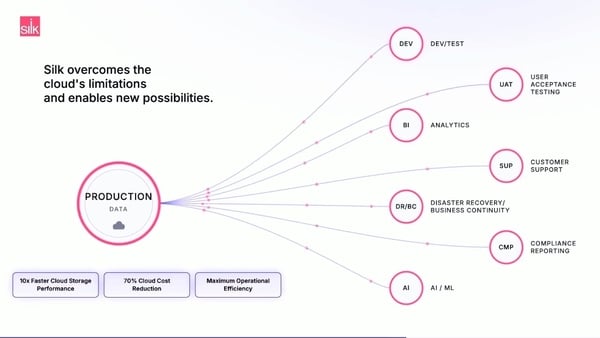
Silk Echo puts a current, full-speed copy of production in front of every team that needs it, from dev/test and analytics to AI and recovery. Copies are ready in minutes, cost nothing extra to store until data changes, and never slow the systems that run the business.

Every Team Wants a Copy of Production

Dev, QA, UAT, analytics, AI agents, support, compliance and disaster recovery all need current production data, and the number of copies and refresh requests keeps climbing. In native cloud architectures every copy is another full dataset to buy, provision and wait for. So teams ration environments, queue for a shared UAT, and build, test and train on data that is weeks old.

Fresh, Fast and Free: Stop Picking Two

A usable copy of production has to be fresh, fast and free at the same time. Most enterprises have already traded one away, and whichever they gave up tells you which initiative is stuck.

What a copy needsTest data management toolsBackup and legacy CDMNative cloud storageSilk Echo
FreshMatches productionNo. Refreshed weeks or months apartYesYesYes. Create or refresh a copy in minutes
FastReal work runs on itYesNo. Built to protect data, not to serve itPartly, on premium tiers and large VMsYes. Served by the same data plane as production
FreeNo second copy of capacityYesYesNo. Every copy buys the whole dataset againYes. Capacity only for the blocks that change

Silk Echo: Copy Data Management at the Database Layer

Silk Echo is the heart of Silk copy data management. A lightweight database host agent works with Silk's instant, zero-footprint snapshots and clones to deliver full-function database copies, through a simple UI or a full API, while production stays untouched. Silk Echo supports Microsoft SQL Server, Oracle and PostgreSQL databases.

Database-aware copies

Echo coordinates each snapshot with the database itself, so every copy is a working database, not a raw volume. Choose application-consistent or crash-consistent operations.

One source, many hosts, one run

Clone a production database to one or many destination hosts in a single operation. New environments are ready in minutes, not the days a full copy and restore takes.

Zero footprint by design

Redirect-on-write snapshots and thin clones use no capacity when created and grow only with the changes each team writes. Inline deduplication and compression shrink the rest.

Copies that perform like production

Every copy runs on the same Silk data plane as production, with no slower second tier and no appliance in the data path. Reads from a clone nearly mirror the source volume.

Built for automation

Drive Echo from its UI or through the REST API, CLI, PowerShell and Terraform. Trackable tasks drop straight into CI/CD, so lower environments refresh on every build.

Self-service with guardrails

Developers, analysts and data teams create their own copies under role-based access, SSO/SAML and encryption at rest, and pair them with your data-masking tools. DBAs get their time back.

From One Production Database to Every Team

Every Silk Echo copy starts from the same point-in-time snapshot.

Production database

Running on Silk, at full speed

Instant snapshot

Point in time, pointers only, no data copied

  • Clone · Dev and CI/CD
  • Clone · QA and UAT
  • Clone · Analytics and BI
  • Clone · AI and agents

Refresh or rewind

Re-sync to current production, or roll back, in minutes

Retire or keep

Delete when done, or hydrate into a full, independent copy

Thin clones start at zero footprint and grow only with the changes each team writes. Snapshots can be mounted across zones, regions and clouds.

The tenth copy costs what the first one did

Watch the Video

One Copy Workflow for Every Team

Silk Echo replaces a patchwork of copy-heavy processes with one fast, governed way to deliver production data.

Dev/test and CI/CD

Give every developer and every pipeline a writable, production-accurate environment, refreshed on every build. Run parallel UAT environments instead of queuing for one.

AI, agents and analytics

Feed models, RAG pipelines, BI and AI agents live production data, and move read-heavy work onto a copy so production keeps its SLAs.

Agent sandboxes →

Database operations and recovery

Recover from corruption or a bad release by rewinding to a clean point-in-time copy, instead of hauling terabytes back from blob storage for hours.

Data resilience →

Compliance, audit and DR testing

Answer auditors with immutable, point-in-time snapshots, and prove disaster recovery on production-grade copies instead of scaled-down test beds.

Support and troubleshooting

Reproduce a customer-reported issue on an exact copy of production in minutes, test the fix, and throw the copy away.

Migration and ETL validation

Test schema changes, upgrades and ETL pipelines against full, current data in isolation, then apply them to production with confidence.

Proven on Enterprise Production

Forrester Consulting measured the impact of Silk across customers running performance-sensitive databases in the cloud.¹

“We can offload workloads from production and provide the same capabilities on a secondary copy, essentially at no additional cost.”
CTO, healthcare, on Silk Echo, interviewed for the Forrester study¹

139%

Three-year ROI

<6 months

Payback

15%

DBA productivity lift from faster refreshes and provisioning

50%

Lower cloud storage cost

Customer Results

Sentara Health

UAT refreshes cut from days to minutes for a 100+ person delivery team

Challenge: Nightly refreshes ran 14 to 17 hours and UAT refreshes took days, so a 100+ developer and QA team shared a single environment and tested against aging data while racing toward a strategic go-live.

Result: With Silk zero-footprint clones, refreshes take minutes. The team now refreshes far more often, tests against current data, and runs multiple UAT environments in parallel because extra environments no longer carry the cost of full copies.²

15 minutes

Nightly refresh, down from 14 to 17 hours²

20%

Lower Microsoft Azure cost²

SimCorp

Customer onboarding from weeks to hours

SimCorp uses Silk's instant cloning to stand up new customer environments for its investment management SaaS in hours instead of weeks, accelerating SaaS adoption and customer satisfaction.²

Weeks → hours

Time to onboard a new customer²

Frequently Asked Questions

What is Silk Echo?

Silk Echo is Silk's database-aware copy data management capability. It combines a lightweight database host agent with Silk's instant, zero-footprint snapshots and clones, so teams can create, refresh and retire full-function database copies through a UI or API in minutes.

How is this different from backup-based copy data management?

Backup and legacy CDM platforms keep copies on a separate, slower tier because they were built to protect data. Silk Echo copies live on the same data plane as production, so they are current and fast enough to run real dev/test, analytics and AI work, not just to restore from.

Do copies consume extra storage?

Not at creation. Snapshots and thin clones are pointer-based and consume capacity only for blocks that change after they are made, so storage cost tracks your data change rate, not the number of copies. Inline deduplication and compression reduce it further.

Will copies slow down production?

No. Snapshots are created instantly with no performance impact, and the work each team does lands on its own copy. Silk governs performance across workloads, so broader data access does not slow mission-critical applications.

Which databases and clouds does Silk Echo support?

Silk runs on AWS, Microsoft Azure and Google Cloud. Silk Echo supports Microsoft SQL Server, Oracle and PostgreSQL databases.

Can we automate refreshes in our pipelines?

Yes. Echo operations are available through a full REST API, CLI, PowerShell cmdlets and a Terraform provider, and tasks can be tracked through REST endpoints. Teams commonly schedule Echo in CI/CD to refresh lower environments on every build.

How do we protect sensitive data in copies?

Silk works with the data-masking tools you already use: mask a snapshot once, then clone masked copies to the teams that need them. Role-based access, SSO/SAML, CHAP host authentication and native encryption at rest govern who can create, attach and delete copies.

Can copies run in another region or cloud?

Yes. Snapshots can be mounted across zones and regions, and across cloud providers, which supports distributed teams, DR exercises and multi-cloud strategies.

Go Deeper on Copy Data Management

Solution brief

Accelerate dev/test velocity with Silk

Read the brief →

Analyst study

The Total Economic Impact™ of Silk

Read the study →

Blog

12 ways Silk Echo supercharges AI and modern workflows

Read the post →

Put a Number on Data Agility

In a 30-minute Cloud Efficiency Assessment, we baseline how long your teams wait for environments and what you spend on non-production storage and compute, then model it side by side with Silk.

  1. 1. 1. The Total Economic Impact™ Of Silk, a commissioned study conducted by Forrester Consulting on behalf of Silk, May 2026. Results are for a composite organization based on interviewed customers.
  2. 2. 2. Customer results as reported by Sentara Health and SimCorp; individual results vary.