
Hit Your Claims SLAs in the Cloud
Run core administration platforms like TriZetto® QNXT™ and Facets™, member platforms, and claims analytics in AWS, Azure, or Google Cloud at production speed on smaller VMs. Give every team, including AI, a fresh copy of production in minutes. No refactoring.
Trusted by health plans and benefits administrators


to refresh UAT from production at Sentara Health Plans, down from 5–7 days
faster than Azure Ultra Disk for HealthEquity's business platform
Native Cloud Storage Wasn't Built for Claims Workloads
Health plans are moving core admin platforms to the cloud under pressure to contain administrative cost, prove resilience, and put AI to work on claims. Native cloud storage forces a trade-off on all three.
Claims batches outgrow their windows
Core admin platforms run claims, enrollment, and membership on heavy batch and change-data-capture jobs. Native disks cap IOPS by VM size, so those jobs run longer than they did on premises, spill into the business day, and slow claims turnaround.
Paying for compute to buy storage speed
The usual fix is bigger memory-optimized VMs and more premium disks. That also raises per-core SQL Server licensing. With cloud bills already running ahead of budget, it is the first line item an admin-cost review questions.
Every copy adds cost and another place PHI lives
Configuration testing, UAT, SIT, reporting, training, and now AI for prior authorization, payment integrity, and member service all want production data. Refreshing a full copy for acceptance testing is manual work that can take a day or more.
Resilience is tested by auditors and outages
Daily recovery points and backups that run for hours fall short for systems that pay claims. A cloud maintenance event or regional outage should not become a member-facing incident.
With Silk, Run the Systems Your Plan Can't Afford to Slow Down
Silk is a software-defined cloud data platform that runs in your own cloud account, beneath your databases. Core plan systems move as they are and get faster on less infrastructure.
Core administration and claims
Silk supports TriZetto QNXT and Facets on SQL Server across production, acceptance, and DR. Claims batches get sub-millisecond latency and IOPS that don't depend on VM size, and UAT, SIT, and acceptance environments refresh from production in minutes.
Member, benefits, and payments platforms
Consumer-facing platforms spike with enrollment and benefit cycles. Silk holds latency steady through the peak without overprovisioning for it all year.
Claims data warehouse and reporting
Warehouse and reporting servers run on smaller VMs, and reporting copies refresh from production without loading it.
AI on live claims and member data
Prior authorization, payment integrity, and member-service AI need current data. Each model or agent gets its own isolated, full-speed copy, inside production's controls.
Better Than Native Performance, in the Cloud You Already Use
Meet claims windows
Silk aggregates performance across nodes, so a single claims database gets sub-millisecond latency at IOPS levels a native volume can't reach.
Right-size compute and SQL licensing
Performance no longer depends on VM size. Run fewer vCPUs and license fewer SQL Server cores.
Give every team fresh production data
Zero-footprint snapshots and thin clones refresh UAT, SIT, reporting, training, and AI environments in minutes, with near-zero added storage.
Built for PHI
Silk runs inside your cloud tenant and network. Copies stay inside production's controls and work with your data-masking tools.
Recover in minutes, across regions
Zone-level high availability, region-to-region replication, and recovery points every few minutes instead of once a day, with DR testing on production-grade copies.
Buy it the way you buy cloud
Available on AWS, Azure, and Google Cloud Marketplaces, so Silk can draw down existing cloud commitments.
Moving QNXT or Facets to the Cloud? Start With the Data Layer
Core admin migrations stall on the same pattern: claims batches run slower in the cloud than on premises, acceptance refreshes take days of manual work, backups run for hours, and the native fix is oversized VMs and premium disks.
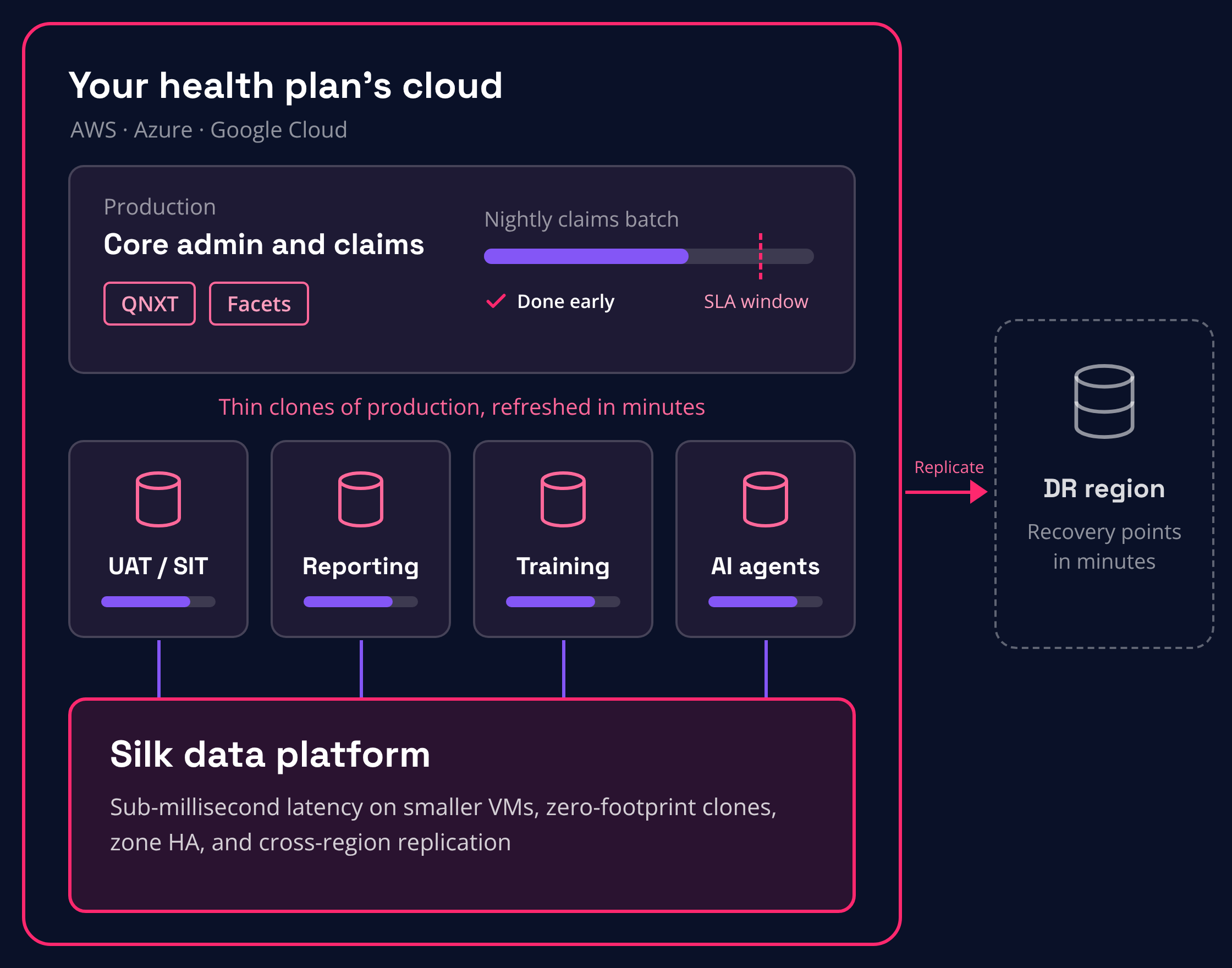
Silk sits beneath production, high availability, reporting, test, training, and DR. Production gets zone-level HA and cross-region replication. Every lower environment is fed from production by thin clones, not full copies. Your systems integrator keeps its migration plan; nothing in the application changes.
Capacity grows online, so a large new employer group or adjacent systems like document management, CRM, and messaging can move onto the same platform without a procurement cycle. Cutover follows a deployment playbook with a defined rollback plan.
Primary region
Claims SQL Server on Silk across two availability zones, with zone-level high availability
DR region
Region-to-region replication, with recovery points every few minutes
Lower environments
UAT, SIT, acceptance, reporting, training, and AI fed by zero-footprint thin clones, refreshed in minutes
Health Plans and Benefits Leaders Run on Silk
Fresh production data for every QNXT release
Refreshing the QNXT UAT environment from production took 5 to 7 days, so about 100 developers and testers worked on aging data ahead of major releases.
Zero-footprint snapshots and thin clones create a full-performance copy of production in about 15 minutes, with no load on production. Warehouse and reporting servers run on smaller VMs.
“Silk provides a platform to really address your data in a cost-effective way, so you can do the right things with that data.”
Jeff Thomas, SVP and Chief Technology Officer, Sentara Health
UAT refresh from production, down from 5–7 days
developers and testers on fresh production data
A monolithic benefits platform moved to Azure without a rewrite
HealthEquity's HSA and benefits platform sees sharp demand spikes with benefit cycles. In load testing, parts of it couldn't perform on native Azure storage.
Silk let the team lift and shift its monolithic database to Azure and meet its performance targets without refactoring.
“We would not be able to do our lift and shift and start our modernization without Silk.”
Mervyn Lally, CIO, HealthEquity
faster than native Azure Ultra Disk
consistent latency
cost savings
Frequently Asked Questions
Do we need to refactor QNXT, Facets, or other core admin applications?
No. Silk runs beneath your databases on standard cloud VMs in your own account, so applications, schemas, and DBA processes move as they are.
How do we prove Silk on our workload and reduce cutover risk?
Start with a proof of concept on your own claims workload, measured against success criteria your team sets: batch run times, latency, refresh times, backup and recovery points, and online growth. Production deployment then follows a playbook with a defined rollback plan.
Which core admin platforms, databases, and clouds does Silk support?
Silk customers run TriZetto QNXT and Facets on Silk today. Silk also supports any similar core admin or claims platform built on Microsoft SQL Server, Oracle, or other block-storage workloads, running in AWS, Azure, or Google Cloud.
How does Silk handle PHI?
Silk runs inside your tenant and network, and copies stay inside production's access controls and masking processes. Silk supports your HIPAA program; it is not a substitute for it.
How does Silk lower compute and SQL Server licensing cost?
Native disks tie IOPS to VM size, so teams buy large VMs for storage speed. Silk decouples the two, so VMs and licensed cores are sized to the workload.
How do analytics and AI teams get production claims data without risk?
Thin clones give each team an isolated, full-performance copy in minutes, with no load on production and near-zero added storage.
How does Silk support disaster recovery for claims systems?
Silk removes single points of failure across nodes and zones and replicates region to region. Recovery points move from once a day to every few minutes, and you can test failover on production-grade copies.
Can Silk absorb growth from new groups or open enrollment?
Yes. Capacity and performance scale online in minutes, without downtime, application changes, or a new procurement cycle, so a large new employer group or an adjacent workload doesn't become a new project.
How do we buy Silk?
Through AWS, Azure, and Google Cloud Marketplaces, or through the resellers and systems integrators you already buy from, so purchases can count toward cloud commitments.
See Your Numbers Before You Commit
Sources
-
1
The Total Economic Impact™ of Silk, a commissioned study conducted by Forrester Consulting on behalf of Silk, May 2026. Results are for a composite organization based on interviewed customers: 139% ROI over three years, 50% reduction in cloud storage cost, payback in under six months.
-
2
TriZetto, QNXT, and Facets are trademarks of Cognizant or its affiliates. Customer results are specific to each customer; individual results vary.