Solutions / Retail

Retail Performance That Holds at Peak, Without Paying for the Peak All Year

Checkout, POS, inventory and pricing systems can’t slow down when traffic spikes. Silk gives retail databases up to 100× faster performance with sub-millisecond latency in the cloud, scales performance up for holidays and promotions and back down after, and cuts the overprovisioning that inflates your cloud bill.

Where Retail Performance Breaks

Four workloads that all peak at the same moment, on cloud infrastructure that ties performance to size.

Peak-season database load = transactions + inventory + analytics + copies

Transactions

Checkout, POS and order processing must stay responsive while traffic multiplies during holidays, drops and promotions.

Inventory

Real-time stock, fulfillment and order management hit the same databases harder as every channel sells at once.

Analytics

Pricing, personalization and demand forecasting need fresh data, competing with production for I/O.

Copies

Dev/test, promo testing, analytics and DR each need their own full copy of production.

Silk handles every term at sub-millisecond latency, without sizing your cloud for the peak all year.

Four Ways Silk Keeps Retail Systems Fast

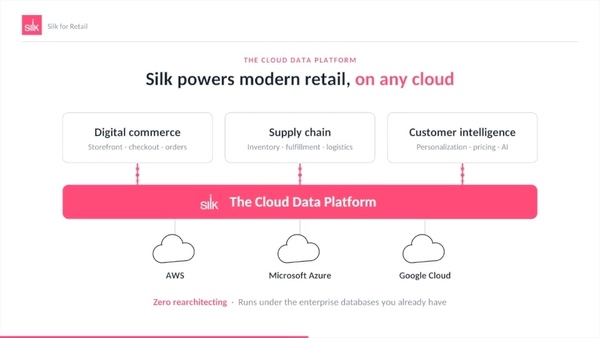
Silk sits between your retail applications and cloud infrastructure, delivering the performance of on-prem or better on Azure, AWS and Google Cloud.

Fast checkout at any volume

Up to 100× faster database performance and sub-millisecond latency keep checkout, POS and order processing responsive, so a slow transaction never costs you a sale.²

Predictable performance →

Scale for seasonal spikes

Add Silk performance online for Black Friday, holidays and launches, then scale back when demand drops. No data movement, no downtime, no resizing VMs.

Run analytics without the drag

Zero-footprint clones give pricing, personalization and forecasting teams full-performance copies of production in seconds, without slowing the systems that take orders.

Copy data management →

Modernize without rewrites

Move SQL Server and Oracle retail applications to Azure, AWS or Google Cloud as they are. Silk is a software-defined data layer: no refactoring, no new database.

Built for Black Friday, Not Just for Tuesday

What changes when database performance stops being tied to the size of your infrastructure.

Native cloud alone

  • Latency climbs at checkout just as traffic peaks
  • Infrastructure sized for the holiday rush, paid for all year
  • Analytics and reporting compete with production for I/O
  • Scaling means resizing VMs, retesting and change freezes
  • Every dev/test and promo-testing copy is a full, billed copy

With Silk

  • Sub-millisecond latency at peak volume
  • Add performance for the season, remove it after, online
  • Analytics run on zero-footprint clones, not production
  • Scale without downtime or application changes
  • Copies take no space until data changes

And Stop Paying for the Peak All Year

In native cloud, performance comes bundled with size. To survive the holiday rush, retailers buy larger VMs, premium disks and capacity sized for their busiest day, then pay for it in every quiet month. Licensing climbs with every extra core, and every copy of production adds another full bill. Silk decouples performance from capacity, so you pay for what your workloads actually use. Customers have cut cloud costs by up to 69% and VM costs by up to 76%.²

Cost of one database on native cloud Data + IOPS Unwritten capacity Data + IOPS Larger VM Unwritten capacity Data + IOPS Extra licenses Larger VM Unwritten capacity Data + IOPS × every copy Licenses VM Unused Data Workload need What the database uses Size for IOPS Buy capacity to reach a tier Upsize the VM Cores bought for throughput License the cores SQL Server, Oracle per vCPU Copy it all Dev/test, analytics, DR = A bill that grows faster than the workload

Measured by Forrester

Forrester Consulting interviewed Silk customers and modeled a composite organization with $2 billion in annual revenue. The result: faster applications, lower storage and compute costs and more productive DBA teams.¹

“Silk also makes costs much more predictable. We can calculate and forecast storage and cost needs far better, and it’s more manageable. With regular disks, you’re always heavily overprovisioning, whereas with Silk we really pay for what we use, and that’s a big benefit.”
Director of product management, software, in The Total Economic Impact™ Of Silk¹

139%

Three-year return on investment

$6.3M

Net present value over three years

<6 months

Payback period

50%

Reduction in cloud storage costs

  • $9.8MCloud infrastructure cost savings
  • 60%Improvement in application performance
  • 15%Productivity lift for the DBA team

How Silk Changes Retail Operations

The same retail database workloads, run two ways.

Retail requirementNative cloud storageSilk
Checkout and POS latencyRises as traffic and I/O contention growSub-millisecond, even at peak volume
Holiday and promotion peaksBigger VMs and premium tiers, kept all yearAdd performance online, remove it after the season
Analytics and reportingCompete with order processing for throughputRun on zero-footprint clones, isolated from production
Dev/test and promo testingFull copies, each billed in fullFull-performance copies in seconds; store only changes
Compute and licensingCores added for I/O, licensed per vCPUSmaller VMs, fewer licensed cores
Moving to the cloudRefactor or accept slower performanceLift and shift SQL Server and Oracle as is

Retailers and Digital Leaders Run on Silk

Enterprises run their most demanding SQL Server and Oracle databases on Silk, fast at peak and leaner all year.

Wayfair

Built for the speed of online retail

Wayfair, one of the world’s largest online destinations for furniture and home goods, relies on Silk to keep critical database workloads fast in the cloud, where every millisecond at checkout counts.

With Silk, customer-facing workloads keep sub-millisecond response times when demand surges, and performance scales independently of capacity, so peak readiness doesn’t mean paying for peak infrastructure all year.

Up to 100×

Faster database performance³

Sub-ms

Latency at peak demand³

Up to 69%

Lower cloud costs³

5×

HealthEquity

Faster performance than Azure Ultra Disk, with latency under 0.5 ms and 36% cost savings on Azure.

Read the story →

69.2%

Sentara Health

Lower cloud storage costs for a Fortune 500 organization, with VM costs down by up to 76% and more than $600,000 saved a year.

Read the story →

<1ms

eToro

Sub-millisecond performance for a 24/7 trading platform on Azure, where every transaction has to clear instantly, on more cost-effective E-series VMs.

Read the story →

Is Silk a Fit for Your Retail Environment?

If one or more of these describes your environment, there’s a strong case for Silk.

  • Checkout, POS or order processing slows down during holidays, drops or promotions
  • You size cloud VMs and storage tiers for your busiest day and pay for them all year
  • Pricing, personalization or inventory analytics compete with production databases
  • You run SQL Server or Oracle retail applications you want in the cloud without refactoring
  • You keep multiple full copies of production for dev/test, analytics or DR

Be Ready for the Peak Without Paying for It Year-Round

Microsoft Azure savings calculator

Compare your current Azure storage and VM configuration with Silk and see the estimated savings.

Calculate Azure savings →

AWS savings calculator

Model what Silk would save on your AWS storage and EC2 footprint.

Calculate AWS savings →

Build the Retail Business Case

Solution briefs, analyst research and guides for running retail in the cloud.

Silk and Retail on the Cloud

Solution brief on running e-commerce, POS and inventory systems in the cloud with speed, scale and security.

Download the brief →

Silk for SQL Server retail customers

How retailers get on-prem performance or better for SQL Server in the cloud.

Read the one-pager →

The Silk platform and retail workloads

Running retail workloads on Azure with the performance AI and online shopping demand.

Read more →

The Total Economic Impact™ Of Silk

Forrester report on the costs and benefits of Silk for a composite organization.

Read the report →

See Silk Run Your Peak Season

Tell us about your retail databases and busiest trading periods, and we’ll show you the performance and savings, with every assumption shown.

  1. 1. The Total Economic Impact™ Of Silk, a commissioned study conducted by Forrester Consulting on behalf of Silk, May 2026. Results are for a composite organization based on interviews with five decision-makers at four organizations using Silk. Benefits are three-year, risk-adjusted present values.
  2. 2. Silk customer results. Ranges reflect individual customers; not all workloads benefit from every Silk efficiency gain.
  3. 3. Silk platform results across customers and benchmarks; not specific to any single customer named on this page.