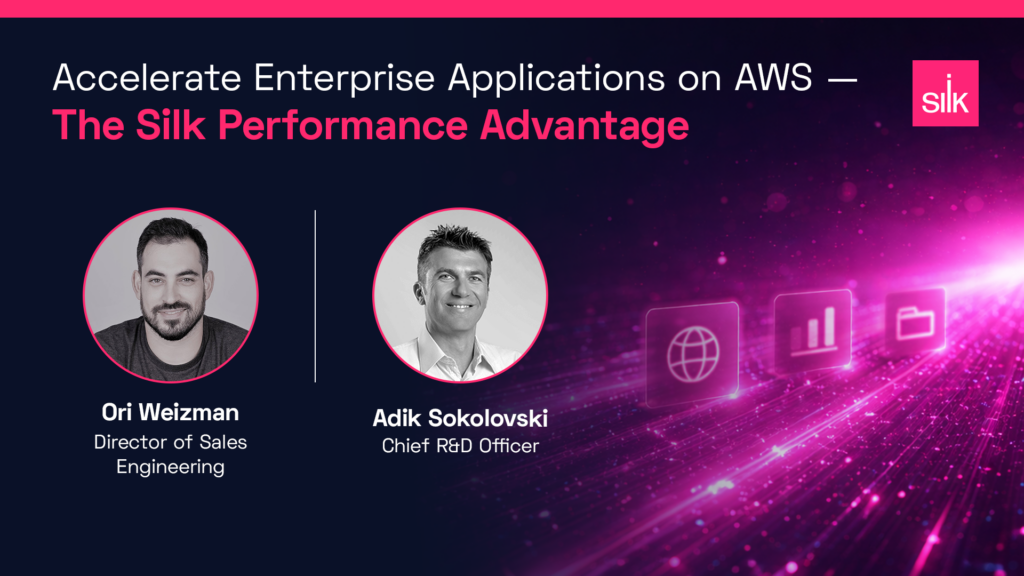
Accelerate Enterprise Applications on AWS — The Silk Performance Advantage
Webinar Transcript
Isabella:
Welcome, everyone. We’ll give it another moment as people join.
Ori Weizman:
How about a quick dad joke in the meantime?
Isabella:
Love it—let’s hear it.
Ori Weizman:
Why did the DBA get kicked out of the bar?
Isabella:
Why?
Ori Weizman:
Because he kept joining tables without permission.
Isabella:
That’s a good one. Before we get started, a few quick housekeeping notes: this session is being recorded, and you can submit questions in the chat—we’ll address them at the end. We’ll also share materials and contact information afterward.
With that, I’ll hand it over to Ori.
Introductions
Ori Weizman:
Thanks, Isabella. I’ll start with a quick introduction. I’m Ori Weizman, Director of Sales Engineering for EMEA at Silk. I’ve been with the company for nearly five years, coming from a consulting background in enterprise environments.
Joining me today is Adik Sokolovski, our Chief R&D Officer. Adik, would you like to introduce yourself?
Adik Sokolovski:
Thank you, Ori. I’m the Chief R&D Officer at Silk and have been with the company for over a decade. I’ve spent more than 20 years leading development organizations across companies like IBM, Neustar, and Amdocs. My focus has always been on turning innovation into practical solutions that solve real customer challenges. I’m glad to be here.
The Silk Story
Ori Weizman:
Adik, you’ve been with Silk for over 10 years. Can you share a bit about how the company got started?
Adik Sokolovski:
Absolutely. Silk’s origin is rooted in solving internal challenges. Years ago, we faced significant CapEx constraints and needed to accelerate testing. That led us to experiment with emulating environments in the cloud.
What started as a way to improve development efficiency quickly evolved into something bigger. As we began moving workloads into the cloud, we realized these early innovations formed the foundation for a cloud-native performance platform.
Instead of starting from scratch, we built on existing technology and evolved it into what Silk is today.
Platform Maturity
Ori Weizman:
It’s interesting how many great technologies come from solving internal problems first. Today, Silk is in its eighth generation, correct?
Adik Sokolovski:
That’s right. It’s a deep-tech platform with 23 patent families across multiple regions. It reflects years of innovation and development.
Ori Weizman:
We estimated over 1.5 million development and testing hours have gone into the platform. This is a mature, enterprise-grade solution designed for mission-critical workloads.
AWS General Availability
Ori Weizman:
We’re also announcing that Silk is now generally available on AWS. Adik, can you share more about that journey?
Adik Sokolovski:
Certainly. When we first entered the public cloud space, AWS wasn’t our initial focus. But over time, strong demand from customers and partners made it clear that AWS support was essential.
I’m happy to say that as of the end of April, Silk is fully GA on AWS.
Ori Weizman:
This is a big milestone, especially in today’s multi-cloud world where organizations want flexibility and reduced vendor lock-in.
Adik Sokolovski:
Exactly. Many customers already run workloads across multiple clouds—for example, production in one cloud and disaster recovery in another. With Silk now supporting all three major hyperscalers, customers can operate with complete flexibility.
Performance Challenges in AWS
Ori Weizman:
Let’s talk about performance. Why should organizations care about this?
Adik Sokolovski:
A key challenge in AWS is that many workloads hit EBS bandwidth limits long before CPU limits. Storage performance is constrained by network throughput, which creates bottlenecks.
Silk addresses this by operating over high-speed networking paths, allowing us to bypass those limitations and deliver significantly higher throughput.
Architecture Overview
Ori Weizman:
And this ties into Silk’s architecture, right?
Adik Sokolovski:
Yes. Silk decouples compute and storage. That means:
- You scale performance independently from capacity
- You avoid overprovisioning
- You maintain flexibility
We also use an active-active architecture, ensuring high availability and resilience.
Performance Demonstration
Ori Weizman:
In our demo, we showed a workload running on AWS Graviton instances. What stood out was the ability to achieve near-maximum bandwidth utilization with sub-millisecond latency.
Adik Sokolovski:
That’s correct. Because of our distributed architecture and caching mechanisms, we can deliver consistent, low latency—even under real database workloads.
Ori Weizman:
And compared to native EBS, which typically operates at multi-millisecond latency, this is a significant improvement.
Cost Implications
Ori Weizman:
Let’s shift to cost. Silk reduces costs in three main areas:
- Storage: Eliminates reliance on expensive high-performance EBS
- Compute: Enables smaller VM sizes while maintaining performance
- Licensing: Reduces vCPU counts, lowering database licensing costs
For large environments, this can translate into substantial savings.
Adik Sokolovski:
And that last point is critical. Many database vendors charge based on vCPU count. By reducing compute requirements, customers can dramatically cut licensing costs.
AI and Real-Time Data
Ori Weizman:
Let’s touch briefly on AI. One key advantage Silk provides is enabling real-time AI inferencing directly on production databases.
Instead of moving data into a data lake and waiting hours or days for results, customers can query live data in real time.
Adik Sokolovski:
Exactly. As AI adoption grows, performance demands on databases will increase significantly. Silk ensures customers are prepared for that.
Audience Q&A
Isabella:
We have a question from the audience: When moving workloads from on-prem to AWS, many teams see performance issues—especially around I/O. Is that an infrastructure issue?
Ori Weizman:
Partly. The cloud operates very differently from on-prem environments, especially in how performance is tied to compute.
Adik Sokolovski:
That’s right. Native cloud storage wasn’t designed for all enterprise workloads. That’s why performance often degrades after migration.
Silk bridges that gap by delivering on-prem–like performance in the cloud, without requiring major re-architecture.
Isabella:
Another question: What performance metrics should teams focus on?
Ori Weizman:
Key metrics include throughput, IOPS, and latency. At the application level, metrics like transactions per second are also critical.
Adik Sokolovski:
I’d add that vCPU usage is just as important, due to its impact on licensing costs.
Closing Remarks
Ori Weizman:
That’s all the time we have for questions. Adik, any final thoughts?
Adik Sokolovski:
Yes. The demand for database performance is about to grow dramatically, driven by AI and data-intensive workloads.
Organizations need to be ready for that shift. Silk provides the performance, flexibility, and scalability required to meet those demands.
I encourage you to explore the platform and see it in action.
Ori Weizman:
Thanks, Adik—and thanks to everyone who joined us today. If you have additional questions, feel free to reach out. We’d be happy to continue the conversation.